

1 Acre Farmhouse Land in Haryana: What the Policy Actually Allows
A piece of agricultural land can look ideal for a farmhouse. But in Haryana, owning one acre of agricultural land does not automatically mean that a farmhouse can legally be constructed on it.
The property’s location, land-use status, applicable Development Plan, access, permissions and other planning conditions all matter.
Haryana introduced a specific policy for Eco-Friendly Farmhouses in 2021. In 2023, the government revised the framework for Low Density Eco-Friendly Colonies.
These are related to farmhouse development, but they are not the same route.
That distinction matters if you are looking at 1-acre agricultural land around Jhajjar, Pataudi, Farrukhnagar, Gurgaon or other parts of Haryana.
The first important point: 1 acre and 10–25 acres refer to different things
The 2021 policy provides a route for an individual Eco-Friendly Farmhouse.
The 2023 framework deals with a Low Density Eco-Friendly Colony, where a developer or landowner seeks a licence for a larger planned project.
So:
1 acre ≠ 10 acres ≠ 25 acres
They refer to different development structures.
2021 — Individual Eco-Friendly Farmhouse
The policy dated 17 September 2021 provides for change of land use for an Eco-Friendly Farmhouse in the agricultural zone of the relevant development-plan areas, subject to the prescribed conditions.
The minimum land area is:
4047 sq m — approximately 1 acre.
The policy requires the site to be beyond 500 metres from the urbanisable zone of the respective Development Plan.
The farmhouse is intended as the owner’s main dwelling unit, with permitted ancillary uses such as watch-and-ward/servant quarters and farm or animal sheds.
Only one dwelling unit is permitted under this framework.
This is therefore a policy route for an individual farmhouse — not a general permission to build a residential property on any agricultural parcel measuring one acre.
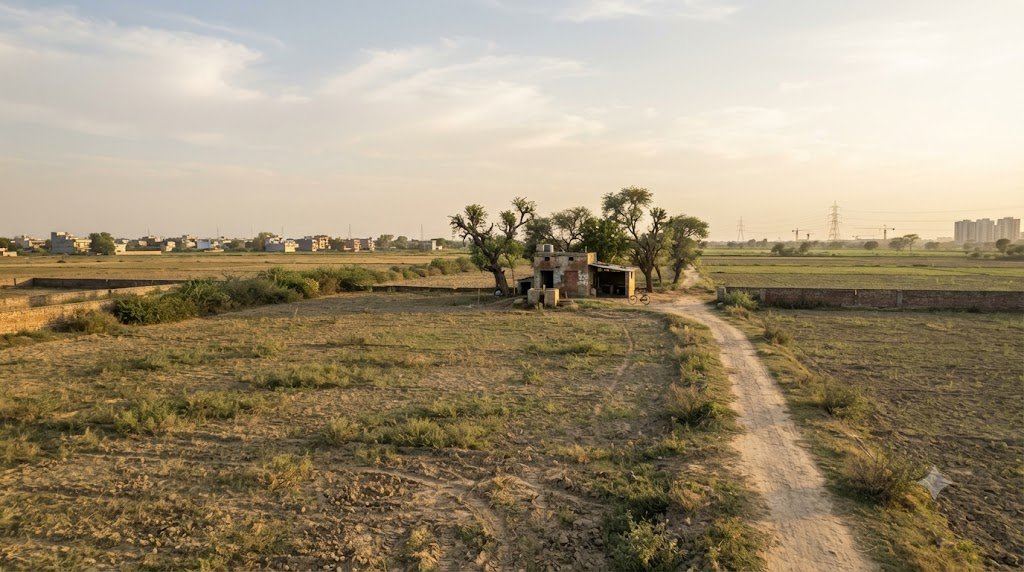
What can be built on 1–2 acres?
For land between 1 and 2 acres, the 2021 policy provides the following main planning parameters:
- Maximum ground coverage: 8%
- Maximum FAR: 0.12
- Maximum height: 11 metres
- One dwelling unit
The policy also requires the farmhouse to function as a self-sustainable unit.
The framework includes requirements relating to:
- Solar water heating
- Rainwater harvesting
- Treatment and reuse of wastewater
- On-site processing of green and animal waste
- Tree plantation over at least 15% of the farm land
- Minimum front setback of 15 metres
- Minimum 6-metre setback on other sides
A swimming pool of up to 50 sq m can be permitted for personal use, subject to the applicable conditions.
Most importantly, commercial use is not permitted under the individual farmhouse policy. Uses such as banquet halls, party halls, recreational, religious or institutional activities are excluded.
So an agricultural parcel should not simply be advertised as a commercially usable “farmhouse property” on the assumption that such use is permitted.
The 500-metre condition is important
For the 2021 individual farmhouse route, location is one of the first things a buyer should investigate.
The policy applies to agricultural-zone land beyond 500 metres from the urbanisable zone of the respective Development Plan.
That distance should not be judged simply by measuring from the nearest city, village or built-up area on Google Maps.
The relevant question is where the property lies in relation to the urbanisable boundary shown in the applicable Development Plan.
This is why a proper planning and location check is more important than simply seeing the words “farmhouse land” in a property advertisement.
Then came the 2023 policy
In April 2023, Haryana revised the framework for Low Density Eco-Friendly Colonies.
This policy is intended for planned colonies, rather than simply taking an individual 1-acre agricultural parcel and treating it as a licensed farmhouse colony.
The revised framework changed the minimum area requirements and introduced planning and infrastructure requirements for such colonies. Contemporary reporting on the revised policy confirms the minimum colony sizes and permitted individual plot range.
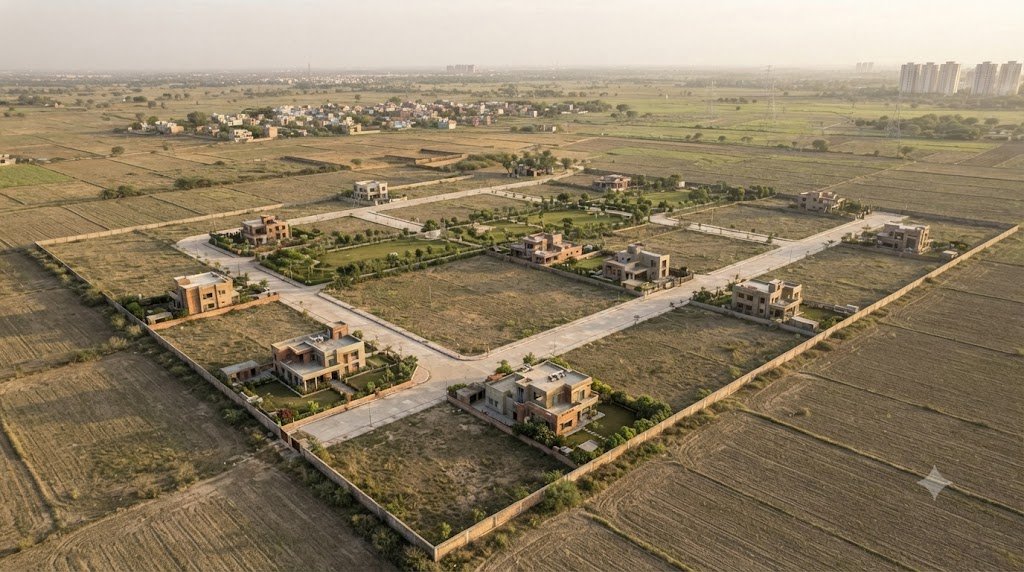
How large must a 2023 farmhouse colony be?
The minimum area depends on the potential zone:
| Potential Zone | Minimum Colony Area |
|---|---|
| Hyper / High Potential | 25 acres |
| Medium Potential | 15 acres |
| Low Potential | 10 acres |
Inside such a licensed colony, individual plots can range from:
1 acre to 2.5 acres.
This is where much of the confusion around “1-acre farmhouse plots” comes from.
A 1-acre plot within a licensed Low Density Eco-Friendly Colony is not the same thing as an independently owned 1-acre agricultural parcel being considered under the 2021 individual farmhouse policy.
What does the 2023 policy allow on individual plots?
The 2023 framework provides different development provisions according to the size of the individual plot.
For plots between 1 acre and 2.5 acres, the policy provides different main dwelling provisions according to plot size, along with controls on height, basement and other development parameters.
The important point for a buyer is that these provisions apply within the framework of the licensed Low Density Eco-Friendly Colony.
They should not be interpreted as permission for an owner of any standalone 1-acre agricultural parcel to construct the same type of development.
The 2023 framework also allows eco-friendly infrastructure and planned community facilities within the licensed colony, subject to the policy and approved plans.
The colony itself has infrastructure requirements
A 2023 Low Density Eco-Friendly Colony is not simply a large agricultural parcel divided into farmhouse plots.
The policy framework includes requirements for eco-friendly infrastructure such as:
- Solar power
- Storm-water storage, purification and recycling
- Sewage treatment and recycling
- Separate water systems for different uses
- Composting of biodegradable waste
- Tree plantation
- Low residential density
Internal roads must be at least:
9 metres wide
The colony also requires appropriate external access and planned infrastructure rather than relying simply on an existing physical road.
The revised framework was specifically designed around planned, low-density development rather than unregulated subdivision of agricultural land.
Do not mix up the two 500-metre provisions
This is one of the most important points in the entire subject.
The 2021 individual farmhouse policy specifically requires the farmhouse site to be beyond 500 metres from the urbanisable zone of the applicable Development Plan.
The 2023 Low Density Eco-Friendly Colony framework has a different treatment of land in relation to the 500-metre zone, including provisions concerning applicable charges for land falling within that area.
Therefore, the two policies should not be reduced to one generic statement that “farmhouse land must always be 500 metres away.”
The applicable policy and the property’s exact planning position have to be identified first.
What does this mean for someone looking for 1 acre?
Suppose you find a 1-acre agricultural parcel in Jhajjar district.
You should not stop at:
“It is one acre, so I can build a farmhouse.”
Instead, the relevant questions include:
1. Where exactly is the land?
Check the applicable Development Plan and the property’s position relative to the relevant urbanisable boundary.
2. Is it in the Agriculture Zone?
The 2021 individual farmhouse route specifically concerns the Agriculture Zone.
3. Does the 500-metre requirement apply?
For the 2021 individual farmhouse route, the property must satisfy the policy’s location requirement.
4. What is the legal access?
The farmhouse framework specifies access through a 6-Karam / 33-foot revenue rasta, or a self-made rasta duly provided/sanctioned in accordance with the applicable requirements.
A physical road visible at the site should not automatically be treated as legally recognised revenue access.
5. What permissions are actually required?
Land ownership and agricultural classification are not the same thing as permission to construct a farmhouse.
Change of land use and applicable building permissions need to be considered according to the particular property and the applicable rules.
6. What exactly is being sold?
There is a significant difference between:
- Agricultural land
- Agricultural land being considered for individual farmhouse use
- Land for which the applicable CLU permission has been obtained
- A plot inside a licensed Low Density Eco-Friendly Colony
A property listing should make that distinction clear.
What about Nangla and Kutani?
For buyers looking around the Jhajjar–Reliance MET region, locations such as Nangla and Kutani are worth examining because their position relative to the applicable development-plan boundaries can be important.
For specific properties, however, the village name alone is not enough to establish farmhouse eligibility.
Each parcel still needs to be checked for:
- Exact location
- Development Plan status
- Agricultural-zone status
- Revenue access
- Ownership and title
- Applicable permissions
- Other statutory restrictions
Why the distinction matters when buying farmhouse land
A farmhouse advertisement can make a property appear straightforward:
“1 Acre Farmhouse Land.”
The actual planning position can be considerably more complicated.
A serious buyer should therefore ask for the actual property facts:
Location. Size. Dimensions. Access. Land use. Development Plan position. Documentation. Permissions. Price.
The phrase “farmhouse land” should come after those facts — not instead of them.
2021 vs 2023: The simple comparison
| 2021 Individual Farmhouse | 2023 Low Density Eco-Friendly Colony | |
|---|---|---|
| Basic concept | Individual farmhouse | Licensed planned colony |
| Minimum land | 1 acre / 4047 sq m | 10–25 acres, depending on potential zone |
| Individual plot | 1 acre and above, subject to policy | 1–2.5 acres |
| Location | Agriculture Zone | Agriculture Zone |
| 500m provision | Beyond 500m from urbanisable zone | Different treatment under the colony framework |
| Internal roads | Individual access requirements | Minimum 9m |
| Main access | 6-Karam / 33-ft revenue rasta or qualifying alternative | Planned external access requirements |
| Main dwelling | Policy-specific | Policy-specific according to plot size |
| Commercial farmhouse use | Not permitted | Commercial exploitation of individual farmhouse plots is restricted |
| Sustainability | Required | Required at colony/project level |
The key difference is therefore not simply 1 acre versus 10–25 acres.
It is:
Individual farmhouse policy vs. licensed planned colony policy.
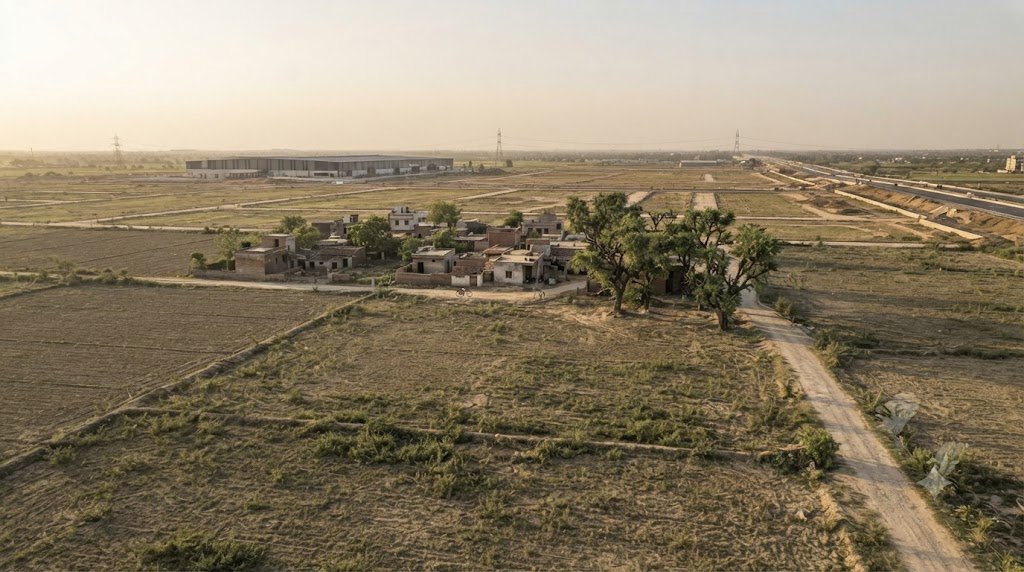
A real Jhajjar example
This is not merely a theoretical planning framework.
A Haryana Assembly committee report records that the Department granted Licence No. 115 of 2024, dated 12 August 2024, for a 37.45-acre site in Jhajjar to Model Economic Township Ltd. (Reliance Haryana SEZ) for setting up a Low Density Eco-Friendly Colony.
The same government record notes that the Low Density Eco-Friendly Colony policy was amended on 21 April 2023 and refers to the eco-friendly infrastructure provisions under that framework.
For buyers and landowners in the Jhajjar region, this is useful context because it shows that the Low Density Eco-Friendly Colony framework has been used for an actual licensed project in the district.
It still does not, however, mean that every nearby agricultural parcel has the same status.
Before buying 1-acre farmhouse land in Haryana
Don’t buy based only on the words “farmhouse land.”
Check the actual parcel.
At minimum:
Development Plan → Zone → 500m position → Revenue access → Ownership/title → Applicable permissions → Physical dimensions → Price
And if someone is selling a 1–2.5-acre plot inside a farmhouse colony, ask for the colony’s licence and approved layout.
Do not assume that the 2021 individual farmhouse policy applies simply because the plot measures one acre.
Frequently Asked Questions
Can I build a farmhouse on 1 acre of agricultural land in Haryana?
The 2021 Haryana Eco-Friendly Farmhouse policy provides a route for an Eco-Friendly Farmhouse on a minimum 4047 sq m (approximately 1 acre) in the specified agricultural-zone circumstances, subject to the policy’s conditions and required permissions.
It is not an automatic construction right merely because the land measures one acre.
What is the minimum land required for a farmhouse colony in Haryana?
Under the revised Low Density Eco-Friendly Colony framework, the minimum area is 25 acres in Hyper/High Potential zones, 15 acres in Medium Potential zones and 10 acres in Low Potential zones.
Can farmhouse plots be 1 acre in a 2023 colony?
Yes. The framework permits individual plots from 1 acre to 2.5 acres within such a licensed colony.
Is a 1-acre agricultural plot automatically approved for farmhouse construction?
No. Land size alone does not establish construction permission. The property’s location, zone, access, applicable policy and required approvals must be checked.
Can a farmhouse be used as a banquet hall or party venue?
The individual farmhouse policy does not permit commercial use such as banquet halls or party halls. The Low Density Eco-Friendly Colony framework also does not turn individual farmhouse plots into general commercial venues. Any proposed use must comply with the applicable approved plan and permissions.
Is every agricultural property in Jhajjar suitable for farmhouse use?
No.
Individual properties must be assessed separately against the applicable Development Plan, zoning, location, access and permissions.
A nearby farmhouse, road, colony or development project does not by itself establish the legal status of another parcel.